
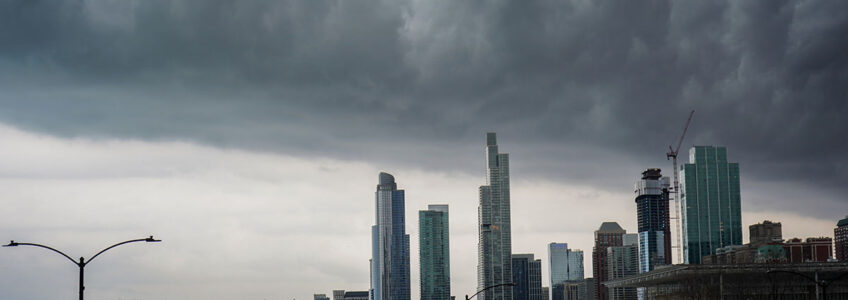
June hits, and the ground is finally workable across Chicagoland. Crews are in the field from Joliet to Waukegan, pads are being poured in the western suburbs, and utility corridors are getting torn up from the south side all the way out to Kane County. Summer is when everything moves — and when everything can go sideways fast.
Here’s something worth taping to the job trailer: the National Weather Service Chicago office reports that northern Illinois sees severe weather on average 25 to 30 days per year, with the majority of those events falling squarely between April and September. Chicago averages more than 6 thunderstorm days in June alone, and another 5 to 6 in both July and August. That’s not a weather forecast — that’s a project management problem. And if your site isn’t set up to absorb those hits, you’ll be eating the downtime costs instead of hitting your milestones.
Weather delays affect roughly 45% of construction projects globally. On a compressed summer schedule in a metro area where permits, labor, and material costs leave almost no margin, that number stops being a statistic and starts being a line item.
The good news is that most of the damage from summer weather on a construction site is preventable. Not all of it — but most.
The Ground Under Your Feet Is the First Thing to Lose
Think of an exposed job site after a heavy rain the way you’d think about a sponge that’s been squeezed too hard. What was solid becomes unstable. Sediment moves. Drainage gets overwhelmed. And if that sediment leaves your property line, you’re not just dealing with a muddy mess — you’re dealing with a potential regulatory violation.
Illinois requires any construction site disturbing one acre or more to obtain coverage under the ILR10 General Permit through the Illinois EPA, with a Stormwater Pollution Prevention Plan (SWPPP) in place before a single shovel breaks ground. That SWPPP has to identify specific erosion and sediment controls — and silt fence is almost always part of the answer.
Silt fence isn’t glamorous. It’s not complicated. But it’s consistently one of the most effective first-line sediment barriers available when it’s installed correctly. The operative phrase there is installed correctly. Silt fence that’s trenched in too shallow, left unrepaired after a storm, or placed on the wrong side of a slope doesn’t just fail — it gives inspectors something to point at. After a significant rain event, it needs to be walked, assessed, and repaired before the next one shows up. In a June where Chicago averages over 10 days with measurable rainfall, that’s not a once-a-month task.
For sites near wetland buffers, drainage easements, or storm sewer inlets — common throughout the DuPage, Cook, and Kane County suburbs — silt fence may also need to be paired with sediment traps or inlet protection depending on SWPPP requirements.
The Perimeter Question Isn’t One-Size-Fits-All
Once erosion control is handled, the next conversation is usually about the perimeter — and this is where many contractors make a decision by default rather than by design.
Where some areas don’t require much in the way of perimeter fence, Chicagoland has a standard for short- and long-term projects: temporary fence panels and post-driven chain link. They’re not interchangeable, and treating them as such is the kind of choice that creates headaches mid-project.
Temporary fence panels are the right call for projects where the footprint is still evolving. No ground disturbance, no post-driving — panels are held upright with metal stands and connected by clamps with bolts, making them easy to reposition as phases progress. If your site layout is going to look different in week four than it does in week one, panels give you that flexibility without the labor cost of a full teardown. They’re also well-suited for sites on hard surfaces — asphalt, concrete, compacted stone — where driving posts isn’t an option.
Post-driven chain link is a different animal entirely. Posts are driven at least two feet into the ground, which means wind events, equipment contact, and foot traffic around the perimeter are far less likely to take the fence down. For long-duration projects, high-security requirements, or perimeters that won’t move once established, this is the more durable and cost-effective choice over time. It’s also worth noting that municipalities like the City of Chicago often require panel fence with privacy windscreen for active construction sites — knowing local ordinances before installation day prevents costly last-minute changes.
Neither Post nor temporary panels work well if you’re guessing. The right choice for perimeter fence on your project depends greatly on your timeline, your site surface, your security needs, and what the local AHJ (authority having jurisdiction) expects to see at the fence line.
The Contractors Who Don’t Scramble Are the Ones Who Planned Ahead
There’s a version of a summer construction project where the GC is making reactive phone calls the morning after a storm — trying to find someone to repair washed-out silt fence, reconfigure a fence line that shifted, or rush in erosion control before an inspector shows. And then there’s the version where those systems were already in place before the weather showed up.
The difference usually isn’t budget. It’s timing. Erosion control and perimeter fencing aren’t things to schedule once everything else is moving — they’re part of the mobilization, not an afterthought to it.
United Rent-A-Fence serves construction sites throughout Chicago and the greater Chicagoland area, installing silt fence, temporary fence panels, and post-driven chain link fence for projects at every scale. The team installs, services, and adapts fence systems as your project evolves — so when the next storm rolls through the metro, your site is ready for it.
Request a quote or schedule your installation online today or call (630) 543-7990. Summer schedules don’t wait, and neither should your site setup.