
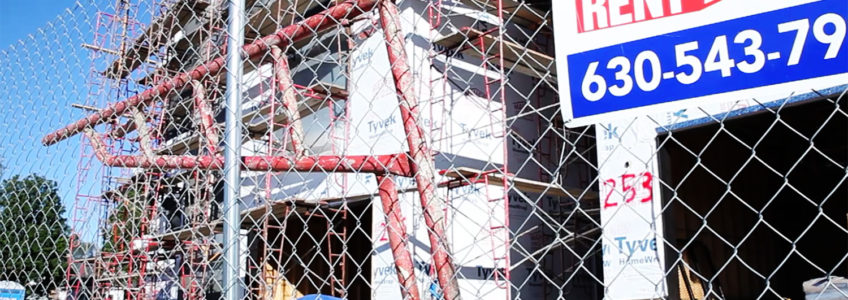
On Chicago jobsites, the story is the same: Friday ends, gates are accidentally left open, tools are left near the fence, and by Monday, a generator and copper wire are gone. Someone scrambles to untangle responsibility. Sound familiar? You’re not alone.
Construction theft in the U.S. has climbed past $1 billion annually. The greater Chicagoland market is not immune. Dense urban corridors, easily accessible suburban sites, and high-value trade materials create a target-rich environment for opportunistic theft. The good news is that most of it is preventable. A temporary fence is the first line of defense.
This article focuses on how experienced Chicagoland contractors use fencing strategically to prevent theft, reduce liability, and improve jobsite efficiency. The main takeaways: consider both perimeter and internal fencing layouts, select the right type of fence for your site conditions and security risks, and don’t overlook proper gate hardware and seasonal maintenance.
The Real Cost of a Poorly Secured Site
Every stolen tool, pile of stripped material, or vandalized equipment adds up. The costs go well beyond the replacement. There’s lost productivity while crews wait for replacements. Insurance claims may lead to a premium increase. Superintendents spend time filing reports. Sometimes, when unauthorized people enter an open site and get hurt, it leads to a liability exposure that dwarfs the value of what was stolen.
Construction theft is rarely a sophisticated, meticulously planned heist. It’s almost always a crime of opportunity. Your best defense isn’t just a CCTV system with 24/7 monitoring — though that doesn’t hurt — it’s making your site look and feel like the wrong target.
A well-installed temporary fence sends exactly that message.
Staging Yard Security: Where Most Contractors Get It Wrong
Most GCs think about the perimeter fence. Fewer think carefully about internal layout — specifically, how materials and equipment are staged in relation to the fence line.
A few principles that experienced supers swear by:
- Stack materials away from the gate and fence line. Anything within arm’s reach of the perimeter is an invitation. Move staged material toward the center of the site, or against a structure, whenever possible.
- Keep high-value items out of sightlines. Copper, electrical equipment, and power tools shouldn’t be visible from the street. This is where the privacy windscreen earns its keep. At 85% opacity, it eliminates the “window shopping” that often precedes job-site theft. In the City of Chicago, a windscreen is actually required by code. Even in the suburbs, it’s worth it.
- Create a secondary internal barrier for equipment yards. When you’ve got a long-duration project with a dedicated equipment staging zone, consider a separate interior fence line using panel fence to create a layered perimeter.
Choosing the Right Fence for the Security Context
Not all temporary fence decisions are equal. The wrong choice can leave your site underprotected or your budget overextended. Our Essential Guide to Choosing Between Post-Driven and Panel Fencing breaks down the technical comparison. Here’s the security-specific version:
Use a post-driven chain link when:
- Your project runs longer than a few weeks, and you can’t afford to have the fence pushed over or breached.
- You’re in an area with high pedestrian traffic or near a roadway where vehicle impact is a concern.
- The site has uneven terrain, and you need a fence that conforms to the terrain and eliminates under-fence gaps.
- You need to run barbed wire or heavier hardware at the top.
Use a panel fence when:
- You’re on a hard surface where driving posts isn’t feasible (pavement, concrete slabs)
- It’s a short-duration project — a facade repair, a tenant build-out, a demo phase — and you need to fence up and down quickly.
- You’re in a dense urban corridor where you need to frequently adjust access points.
The honest answer for most large Chicagoland construction sites is a combination of both: post-driven chain link for the primary perimeter, and panel sections where flexibility is needed near active access points.
Gates, Hardware, and the Details That Matter
A solid fence perimeter fails the moment the gate hardware is weak. Yet gate security is almost always an afterthought. A few non-negotiables:
- Use quality padlocks rated for outdoor use — cheap locks corrode quickly in a Chicago winter.
- Brief every subcontractor crew on gate closure protocol. The fence doesn’t work if a sub props the gate open and leaves at the end of the day.
- Position swing gates to open inward, into the site — not out toward the street, where they can be pushed open.
- For high-risk phases (e.g., when MEP rough-in materials are on-site), consider doubling up with a bar brace behind the gate.
Winter and Off-Hours: When Theft Risk Spikes
Chicago winters are punishing for fence systems and for site security. As we covered in detail in Construction Site Security During Winter Months, shorter days mean longer unmonitored windows. Freeze-thaw cycles can slowly shift fence sections out of alignment, creating gaps that weren’t there in November.
Build a service walk-around into your winter mobilization plan. Check post embedment after hard freezes. Re-tension sagging chain link. Confirm gate hardware hasn’t seized up. A section of fence that’s been heaved two inches out of the ground is a security gap—full stop.
The Operational Checklist
When calling in your fence order, have this information ready:
- Linear footage of perimeter with a rough site sketch or address
- Number and type of gates (personnel, drive-through, width required)
- Surface type (soil, fill, asphalt, concrete — this drives the post-driven vs. panel decision)
- Project duration and whether you expect phasing changes mid-project
- Any Chicago city windscreen requirements or municipality-specific rules
- Timeline — fence should be in the ground before equipment and materials arrive, not after
In summary, planning your fence during the bid phase ensures better pricing, optimal placement, and reduces day-one issues. Key takeaways: prioritize security measures from day one, tailor fencing solutions to your site’s needs, and regularly assess perimeter integrity to mitigate ongoing risks.