
Chicago’s outdoor event season is a logistical marathon, requiring organizers to manage street fests, 5Ks, county fairs, and carnivals year-round. Crowd flow, vendor security, sponsor activations, emergency egress, ADA access, and ticketing must work together within a temporary perimeter that comes together quickly and appears intentional.
Fence layout is where your planning succeeds or fails.
Past articles covered barricade basics and event safety. This article covers how to configure fence and barricade plans for specific event formats, so you have a repeatable framework every time.
The Core Principle: Plan Around Movement, Not Just Perimeter
The most common mistake is treating temporary fencing as just a boundary. A strong fence plan manages how people enter, move within, and exit the event, as well as how they access key areas without bottlenecks.
Before you place a single panel, map out your peak crowd movement:
- Where will most attendees arrive from? (parking lot direction, transit stops, street drop-offs)
- Where will the highest-traffic destinations be? (main stage, food court, bathrooms, ticket gates)
- Where does emergency vehicle access need to remain open?
Every fence panel you place should either guide that movement or protect a zone that shouldn’t be part of it.
Layout Template 1: The Chicagoland Street Fest
Chicago’s summer street festivals are as dense as they come — two to four city blocks closed off, vendors on both sides, a main stage at one end, and thousands of attendees funneling through. Here’s a layout approach that works:
The perimeter: Chain link panel fence is the workhorse here. Panel fence refers to free-standing fence sections that can be set up and taken down quickly, often without needing to be anchored to the ground. It installs fast on pavement without ground penetration, and you can reconfigure it quickly if street access needs change day-of. Run the perimeter along property lines and curb edges, leaving the sidewalk on the outside of the fence for pedestrians who aren’t attending.
Entry/exit points: Minimum two entry points at opposite ends of the event footprint — more for events over 2,000 people. Each entry should have a barricade chicane (a short zig-zag path created with crowd-control barricades to slow people as they enter) to slow ingress and allow ticket scanning or bag checks without creating a crush at the gate.
Emergency egress: Local permit offices often emphasize this. Plan at least one extra exit gate on the long side of the festival, staffed but not used for general entry. It should swing out and remain unlocked during event hours.
Back-of-house: Panel fence sections screen off generator areas, vendor supply staging, and performer areas, keeping the operational guts of the event out of public view — and protecting expensive equipment from wandering hands.
Layout Template 2: The 5K or Charity Run
Road races present a different challenge: a linear perimeter rather than an enclosed one. The fence isn’t holding people in — it’s separating competitors from spectators and, more importantly, from traffic.
Finish line zone: This is your highest-density area. A funnel of crowd-control barricades narrows toward the finish chute, with a panel fence forming the outer perimeter of the spectator zone on both sides, giving you control over a space that can become chaotic fast. Keep a 10–12 foot clear corridor for medical personnel and timing equipment.
Spectator viewing areas: Along the course, orange mesh or barricades mark the spectator edge at key points — mile markers, turnarounds, and finish areas. For more established race routes through parks or forest preserves, post-driven fence can define longer stretches more securely than barricades.
Vendor/sponsor activation zones: These need a separate panel fence perimeter near the start/finish area, with their own ingress so sponsor staff can set up and break down without moving through the athlete corrals.
For a deeper look at the use of fences and barricades specifically for races, the Enhancing Race Events with Panel Fencing post is worth reading alongside this one.
Layout Template 3: The County Fair or Multi-Day Carnival
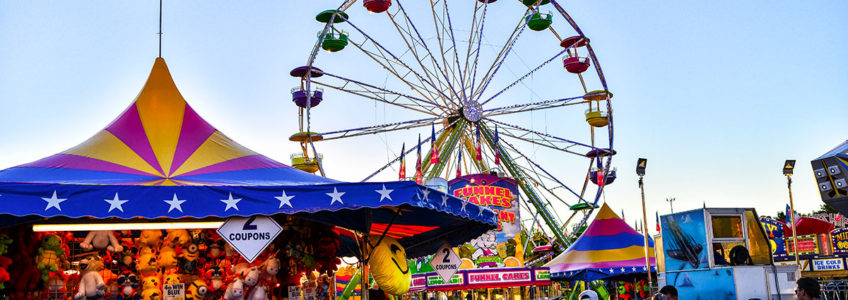
Multi-day events on fairgrounds add complexity: the fence plan needs to withstand overnight conditions, protect vendor inventory between operating hours, and hold up through whatever weather Chicagoland throws at it in September or October.
The perimeter choice: Post-driven chain-link fence provides stability for multi-day events on turf or gravel, as panels on stands may shift or tip in the wind. Avoid a sagging perimeter on Day 2 by choosing stable fencing.
Zone separation inside the perimeter: Use panel fence to create internal zones — midway, animal exhibits, food court, beer garden (often permit-required to be physically separated). Each zone gets its own entry/exit points managed by event staff.
Overnight security: Compress the usable perimeter at night by adding swing gates that lock off vendor areas internally. You don’t need security staff walking the entire fairgrounds — you need a hardened interior perimeter around inventory and equipment.
Layout Template 4: The School or Park District Event
Suburban school fundraisers, park district carnivals, and community fests have specific constraints: smaller budgets, volunteer-managed operations, and grounds that can’t be damaged (no post driving on school turf in most cases).
Panel fence on stands works best for these events. It sets up quickly with a small crew, requires no ground penetration, and the layout can be changed at the last minute if needed.
Parking lot separation: As covered in Safety Tips for Outdoor Event Planners, using an orange mesh fence to create defined parking rows and a clear pedestrian walkway between the lot and the event entrance is a simple addition that dramatically reduces the chaos of family arrivals and departures.
The Details That Make or Break Any Layout
Regardless of event format, a few things apply across the board:
- ADA-accessible entry points must be accounted for in the perimeter plan — not added as an afterthought. Gate openings must be at least 60 inches wide and free of trip hazards at the threshold.
- Branding and wayfinding: Windscreen panels along the perimeter aren’t just for visual blocking—they’re billboard real estate. Windscreen panels are fabric or mesh covers attached to a fence to block wind and add branding space. As we outlined in Creating Hype With A Temporary Fence, branded screens on your perimeter fence can carry sponsor logos, directional signage, and event identity simultaneously.
- Weather contingency: Chicagoland in summer means pop-up thunderstorms. Know in advance which gates open into the site vs. which open outward, so rapid evacuation doesn’t turn into a bottleneck because a gate swings the wrong way under pressure.
- Coordination with local authorities: Most municipalities in the Chicago suburbs require a site plan showing fence layout and emergency egress as part of the event permit application. Having a fence provider who knows the local requirements saves a round of permit revisions.
Start with the Layout, Then Order the Fence
The worst event fence plans are those ordered by the linear foot, with no layout in mind. The best ones start with a rough site sketch — even a hand-drawn one — that maps crowd flow, zones, and entry points before anyone counts panels.
United Rent-A-Fence has served Chicagoland events of every size, and our team can help you work through a layout that fits your event footprint, timeline, and budget. Request a service call or call (630) 543-7990 — we’re available 24/7.